
This piece contains references to loss, flooding, and disaster trauma.
Please take care as you read.
It is encouraged to save this letter for a time and space where you can be truly present with it. Click below
Apple Podcasts (Better Quality)
Spotify
for a carefully crafted listener’s experience to best take in the tone and “heart” of this message as intended by the author.
For the people of the Texas Hill Country — those taken by the floods, and those who remain.

Raging.
Such was the current
that stole from this world
a person whom you love.
Since that storm, another current — a different force, but equally unwavering — torments you day and night in the wake of this tragedy.
Even now, these waters inundate you.
They were unleashed with the deluge that fell from the skies over the Texas Hill Country. But even when those floodwaters began to recede, your
river of grief
was only in its first surge.
Dark. Deafening. Isolating. Overwhelming. Unrelenting. Inescapable.
You feel powerless,
tossed and tumbled like a rag-doll. There are moments when you surface briefly, gasping for air. Just as quickly, however, you’re pulled right back under. Your struggle suffocates you. Even the simple act of breathing becomes arduous and elusive.
Amid the havoc, you spot people on the riverbank. They’re desperate to get to you, to throw you a lifeline. Yet despite all efforts,
you’re out of reach.
You realize you’re not the only one caught in the frenzied overflow. You thrash about, but you can’t seem to catch hold of anything, or anyone, for very long. The other victims of the flood are almost close enough to touch,
but here in the raging waters of your soul,
you’re alone.
Shocked. Hurting. Lost.
This
is grief
in the days and weeks following their passing.
Like the strongest trees uprooted and shattered by the force of the floods,
you’re fragmented.
Part of you died along with them in that river. Another piece of you walks around in your body, trying to go through the motions of the life you had been living. A third is in the throes of what feels like a losing battle to survive this torrent of grief.
You’re not sure which is “you.”
One of these parts?
A different piece at different times?
The sum of them?
Or are you no one at all right now, nothing more than a ghost in your own skin?
It’s hard to know. You’re still figuring out who you are without them in your life.
On the better days, you’re barely keeping your head above water. Too often right now,
you’re drowning.

Searching.
Searching for belongings.
Searching for answers.
Searching for loved ones…
It’s exhaustingly endless. You try to sustain a monumental, deliberate effort and awareness. You’re somewhat strengthened knowing you’re not alone in your quest. You don’t ask for help, but you’re grateful when it’s given. Still, you worry that the requisites of your mission far exceed your own limits.
This toil is an investigation that consumes you physically, mentally, and emotionally. You exert time, energy, and resources. Yet regardless of the status of your physical searches, the costliest currency required of you to see this through
is hope.
Somehow, you find a way to keep paying up.
Of course, the demands of life haven’t disappeared. You’re forced to leave and return, again and again. You wonder how much longer you can keep this up. You wonder
if your hope will give out.
But a larger part of you remains determined.
So you keep searching.
For hours. Days. Weeks.
The longer you persist, the more you sense the naïveté of onlookers who misunderstand you; you’re well aware of the realities. It isn’t lost on you that your searching and your finding
won’t fix things,
won’t make things right,
won’t make you feel better,
and won’t bring them back.
This isn’t just about what your labor might turn up. In part, it is about honoring your loved ones. And the conclusion of a search brings a measure of closure. There’s no simple explanation as to why, but this is something you refuse to give up on.
Still, it feels like gathering a rope with no end in sight. You’ve pulled and pulled but the only end you seem to be nearing
is that of your own strength and sanity.
The events of that fateful night left in their wake a myriad of losses,
each one a unique story of devastating subtraction.
Yet the universal quest you’ve all undertaken
is that you’re searching
for peace.
And the harder you seek,
it seems that all you find
is more pain and sorrow.
Your hope begins to wear thin.
Searching…
But you just feel more lost.

Stillness.
Under…normal circumstances it’s relaxing. Comforting.
An atmosphere in which things are…all right.
But nothing feels “normal” lately. Nothing about this is right.
And quiet has never felt so loud before.
Through the stillness there is an agonizing heaviness that reverberates from within your core—a constant awareness of the empty spaces that were once filled
with their presence, their voice, their laugh, their comings and goings, their…
simple act of just being.
Being here.
Here.
Where they aren’t anymore, and never will be again.
Perhaps you walk around an otherwise intact home. Of course, it’s hard for it to feel like home right now.
You can’t ignore the glaring absence of the soul who made it one,
or their room
which now lies frozen in time.
Bedding undisturbed. Clothes—tucked away neatly in drawers or heaped on the floor—no longer cover the warm skin you once touched. Shoes sit expectantly, but will never again carry those feet to all the places they used to go, or the places they might have gone one day. Little mementos, whose stories you may or may not know, dot the room as evidence of countless details and experiences that added up to a personality.
A soul.
Photographs. Trophies. Medals. Movie ticket stubs. Stickers. Bracelets.
Diaries or journals. Books. Birthday cards. Figurines. Stuffed animals. Hats. Sports equipment. Souvenirs…
The beautiful collection
of ordinary little things
that come with living a very specific, one-of-a-kind life.
A collection that has since ceased to grow,
and has now become a museum.
Stepping into that lifeless space stirs up an overwhelming brew of emotion and memory.
The simple, unaffected door that guards it
becomes a symbol
of a broken connection
to someone without whom you are no longer whole.
Many face a different scene,
one that looks nothing like it did on July 3rd.
Here, “emptiness” looms in a very literal sense.
This plot of land that was once a safe haven
no longer resembles a home.
Incomplete like the relief you fear may never come,
gone is the house or RV that once stood here.
What remains
are the broken bones and internal organs of a building,
or a pile of wreckage strewn across a riverbank.
In truth, it feels more like a crime scene
left by the violent, deadly assault of Mother Nature.
Or perhaps,
it’s a cabin.
A humble structure that for decades housed snores, giggles, whispered secrets,
the scratch of pencils on letters to loved ones, friendly pranks, bedtime prayers,
talk of boys, gossip, tears, songs…
and more.
In an instant,
it was filled instead
with roaring, muddy water,
and the sobs and screams
of little girls.
Afterward, mud caked anything that wasn’t carried away by the floodwaters: floors, walls, beds and bedding.
Teddy bears and other furry friends, jewelry, Camp Mystic T-shirts, toiletries—even the swimsuits worn just hours before in an idyllic river.
Some of you sifted through the wreckage here, hoping to find any of her belongings. You’ll treasure every piece of her that you manage to recover.
As you survey the aftermath,
your heart
feels as broken, scattered, warped, and worn
as the flood debris that flanks these riverbanks.
That swath of destruction serves as a constant reminder of the catastrophe that unfolded here.
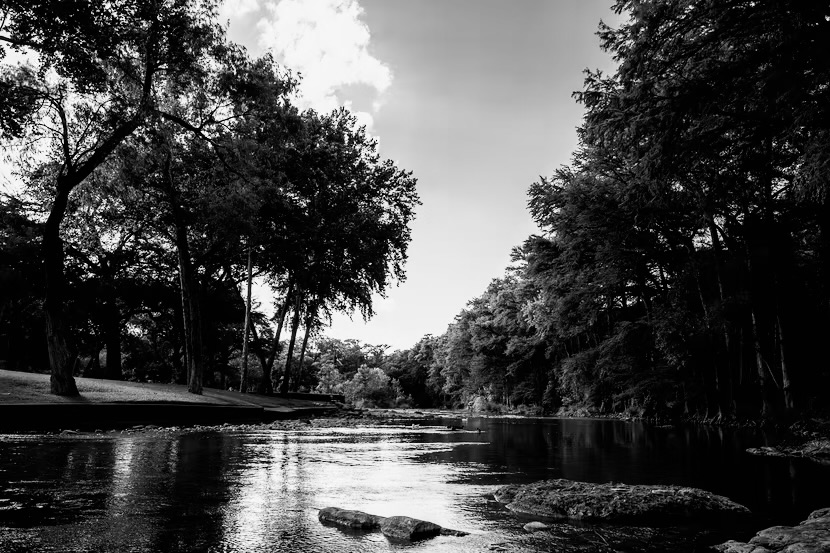
It’s eerie in a way, gazing upon the river’s relaxing trickle now. It’s still nearly impossible to wrap your head around the fact that this place—typically a source of joy and peace—became the site of widespread death and destruction. Even if you could put the image out of your mind, overwhelming evidence blankets the region. Clear indicators show how unthinkably high the water rose, and how ferociously it roared against everything in its path.
Nevertheless, the river itself acts as if nothing is out of place,
even as it flows around leveled trees whose leaves have lost their green.
While you observe the juxtaposition
of the beauty that remains
and the beauty that is removed,
you’re acutely aware of the scars that betray the would-be peace of these scenes
at your home, along the river, and at the campgrounds.
Time will pass, and signs of that night will slowly fade, but you already sense that you’ll never see these places the same way again.
The flood marred the geography in its path, but it also marred your heart in ways not every passerby will notice, let alone understand.
Yet you find the strength to face the scars that cover a world that kept spinning
even when it felt like yours
had stopped.
Everywhere, scenes of unsettling stillness evoke an unavoidable sensation of loss.
Your mind echoes from the quiet:
“Life, too, will never look the same.”
Stillness.
But no peace.

The thing about floodwaters
is that they recede.
There is hope in this truth,
but it must first be recognized
that this fact does not make the initial surge
any less devastating.
It doesn’t fix or undo that which has been broken.
Likewise, in grief
your eyes may see the good among despair,
your head might know hope and truth,
but your heart still aches with a pain
that has taken up permanent residence in your soul.
Some people try to ease your sorrow with bumper-sticker positivity—little bandaids offered up for the gaping wounds of your grief.
This letter is not that, because the truth is,
there are no words to make what happened okay.
It’s not okay.
Even though you may believe that “this, too, shall pass,”
nothing changes the fact
that you’re hurting—
and this letter seeks to make space for that,
to give it a voice.
It’s important—necessary even—to acknowledge and honor your pain. You can’t move forward without accepting where you are.
And right now, it may feel like you’re in a wasteland…
Even as your soul wanders through unfamiliar territory,
the very real, physical world around you doesn’t slow down.
Life never lets up.
You’re left with no choice
but to keep moving.
And so,
the roaring waters that far exceeded limits and expectations left you
putting things,
putting life,
putting yourselves
back together.
It is a rebuilding effort for which you feel vastly under-equipped in every regard.
In the wake of such upheaval,
you’re left wondering:
Where
do you go
from here?

In crisis, we react.
We fight. We flee. We freeze.
We do —
and become
what we can, what we must
to survive.
However, we never remain in that state; it’s unsustainable.
There comes a time when we must shift away from reacting
to responding.
When tragedy struck the Texas Hill Country,
you responded.

Neighbors, strangers, local heroes, and helping hands from far away showed up when it mattered most. Coming together, they offered powerful hope, help, and solidarity.
In the sweltering heat, emergency responders worked double shifts in their commitment to search-and-rescue missions. They pushed past exhaustion to pour every ounce of strength into finding one more person. Determined volunteers crossed county and even state lines to join search teams combing every stretch of the riverbanks. Crews traveled from as far as Mexico and the Czech Republic to lend expertise in the early stages of the crisis.
Closer to home, neighbors grabbed chainsaws and whatever tools they had, cutting through fallen trees to reach victims. Others shoveled thick mud and hauled countless loads of debris by hand. As workers and volunteers labored around the clock, nobody went hungry, either. Through both organized and smaller-scale efforts, folks provided meals on-site, preserving precious time for those working tirelessly.
Meanwhile, with no time left to give, officers made time to go door to door offering face-to-face updates, even when the only news was “no news.” Wherever efforts were underway, grieving families were there too, helping neighbors even as they tended to their own losses.
In the hours and days after the flood, the disaster zone became a stage for remarkable courage and compassion.
There, ordinary people confronted an extraordinary challenge—together.

In the weeks that followed, surrounding communities rallied steadily, supporting families through both emotional hardship and daily living needs. As many grappled with the losses that couldn’t be seen or touched, help poured in to offer tangible necessities.
Swiftly responding to the crisis, local businesses and nonprofits organized donation drives to supply clothing, food, water, and tools—the means to rebuild daily life. Local leaders pledged both essential resources and collective resolve to aid relief and recovery. At the Salvation Army Kroc Center, community members filled trucks with groceries and cleaning supplies. Each delivery was a practical gesture of care for neighbors in need.
Restaurants and shops across the Hill Country gave back to their patrons, contributing portions of their profits to those affected by the floods. Through fundraisers and community drives, churches, businesses, and organizations stepped in to meet urgent needs and come alongside people piecing their lives back together.
Through all the ways communities came together, one message was clear:
“We see you. We’re with you. We’re here to help.”
Kerrville, in particular, held this sentiment close, remembering the words of the late Coach Zunker, who once told his soccer team, “You’ll never walk alone.” In the dark spaces left by those like Zunker—who once carried so much light for others—the community became a team of their own, carrying a new torch for the road ahead.

Another message resonated across both personal and collective grief. It wasn’t shouted—it was softly spoken through simple, yet profound acts. Cutting through the deafening stillness, these gestures made it clear:
“They will be remembered.”
As you sought a path forward, you held fast to honoring those taken by the floods. You stood in solidarity with families who were hurting and healing.
For those present and those passed, you stood together.
Tribute didn’t require fancy banners, elegant displays, or grand parades. It took many forms.
Such as a once-ordinary, chain-link fence along the banks of the Guadalupe. Now adorned with flowers, stuffed animals, photographs, and other mementos, it stands as a testament to the very anthem written on signs along this makeshift shrine. It is a shared, holy ground where “Hill Country Strong” means making space to feel, and to remember.
A week after the flood, hundreds gathered at the memorial wall for a candlelight vigil. Just a few hundred feet from ongoing searches, and with shock still raw, it was a moment when no one grieved alone.
Two days earlier, a similar vigil filled Antler Stadium. On a field normally reserved for Friday night games, the community embraced, sang hymns, prayed, and wept together. That night, it wasn’t a sports arena; it was a church.
Afterwards, people stayed to toss footballs and frisbees, enjoying music and conversation. A youth pastor there remarked, “There is healing in play and laughter.”
Moments like these—both solemn and joyful—reflected the balancing act of grief, remembrance, and renewal in the months to come.

As summer gave way to fall, other global events filled the headlines.
The world moved on from your story, while you were still just beginning to recover and rebuild. Your commitment to those you lost, and to one another, endured.
Nothing erases the loneliness and isolation of grief, but even “the little things” provided a lifeline for the hurting. Through house visits, heartfelt messages, gatherings, and ribbons of green or blue—and every size of gesture in-between—you kept showing up for each other.
Kerr County and other communities had been swept off their feet, but you took each other by the hand and got back up.
In the aftermath, side by side, you carry on.

And so,
You’ve seen it—You’ve lived it:
Floodwaters recede.
Such is the way of water,
and such is the way of grief.
Therein lies our hope.
Crisis ends. A new chapter begins.
Your story is still being written.
You are an author to that tale, not just a reader.
In the face of grief’s power to paralyze,
we must choose
what we do,
and who we are.
You are still you.
Lonely. But not alone. Hurting. But alive. Different. But not done.
We never forget what happened,
or those we lost,
but we do seek—and find—a path forward.

Where We Go From Here
Rivers cease to rage. Their waters settle.
When all that can be done has been done, the searches conclude.
The scenes of aftermath are eventually cleaned up, and slowly take on new appearances, new meanings. The stillness that fills these spaces no longer feels empty, but full of memory.
The world around you changes.
In time, you change too.

Grief is a river that winds through the course of life.
It may have permanently re-shaped the landscape of your heart, but it won’t feel like a flood forever. One day, you’ll wake up and realize that you’re no longer a helpless body carried by grief’s raging torrent. Instead, you will have learned to carry that river inside of you. No longer just the glaring evidence of your loss, it becomes part of the beautifully complex mural that is you.
In your searching, you discover that irrespective of what is and is not revealed amid all your efforts, you can find peace. Maybe not all at once — but little by little, just like the clearing away of a debris pile.
And you find a way to sit with stillness again. Reminders will always surround you. Familiar places, sights, sounds, and even smells bring them to mind. Yet the sting of these memories won’t always be so sharp.
It will soften into the warm afterglow of a soul well-loved — one who was, and will always be, part of your world.

On the Fourth of July, floodwaters changed your lives forever.
There are no quick, pretty words to ease the pain inflicted that night.
We don’t hide it. We don’t run from it.
We face it. Not alone. Together.
United,
we remember, we mourn, and we restore.
That’s where we go from here. That’s how we navigate this river, and keep moving forward — one day at a time,
Together.
This is who you are.
This
is Hill Country Strong.

Ways to Support Survivors
How to Help Texas Flood Victims and Survivors (Team Rubicon Resource List)
This foundation supports causes the girls cared about in each of their communities to ensure their legacies live on.
The Bug and Bee Fund at Creel Family Philanthropies
All donations will go towards counseling, books, resources, and supportive therapy services for families affected by the tragic Hill Country floods.
Resources for Survivors
If you or someone you care about was directly affected by the July 4th floods, my heart is with you. If you need local support — emotional, mental, or practical — please see the list below, and consider reaching out to community partners, crisis teams, or faith groups in your area.
No one should have to navigate this alone.
United Way of Texas: Texas Flooding Resources
2-1-1 Texas: Comprehensive List of Texas Resources
National Alliance on Mental Illness: Mental Health Resources for those affected by the Texas floods
Texas Legal Services Center: Legal aid resources for Texas flood victims
Kerrtogether: Kerrville Area Local Resources
© 2025 John Lewis. This piece may be shared in full for community support, remembrance, or relief efforts. Do not alter or reproduce without written permission. Please credit the author.


Leave a Reply